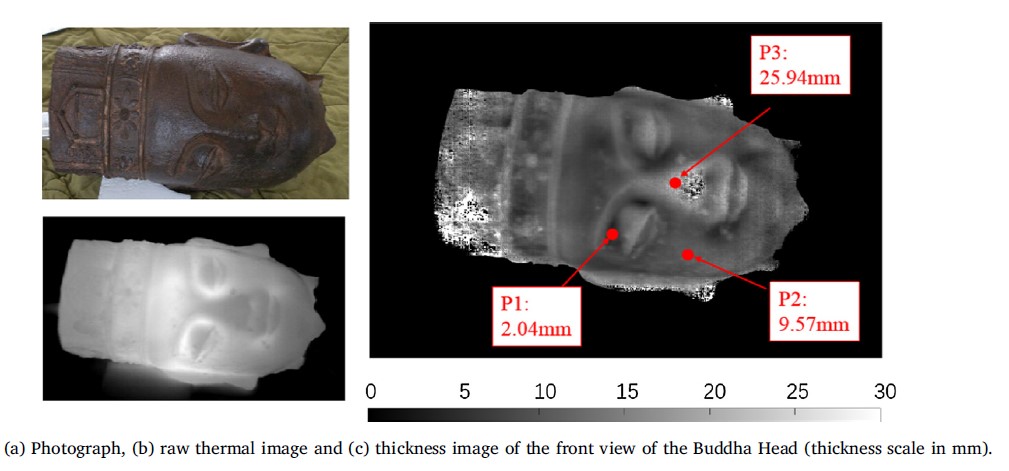
The authors report on the development of a step-heating infrared thermography method for nondestructive evaluation of a cast-iron Buddha head made in the Song Dynasty (AD 960–1279) in China. In particular, this method measures the wall-thickness distribution, which can be used as an indicator for the condition of the object. Unlike other areas of analysis, inspection of cultural relics requires special attention to safety. To avoid the heat shock associated with traditional flash thermography, a step-heating method with a mild heating process is considered to be more acceptable for evaluating cultural relics made from various materials. Before application to inspection of the Buddha head, a numerical analysis and experimental tests were performed to verify the accuracy of this step-heating thickness measurement method. Finally, thickness images of the Buddha head were acquired and analyzed. The step-heating thickness measurement method has a high accuracy and can be safely used for inspecting cultural relics.[Xiaoli Li , Ning Tao* , J.G. Sun , Yong Lei , Liang Qu , Fei Gao , Yi He , Guan Wang, Lichun Feng, Evaluation of an ancient cast-iron Buddha head by step-heating infrared thermography [J], Infrared Physics and Technology, 98(2019), 223-229]